Mourning While Black': Family, Including Dead Woman, Kicked Out of Church by Priest
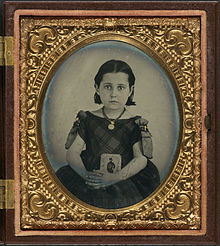
Girl in a mourning apparel holding a framed photograph of her father, who presumably died during the American Civil War.
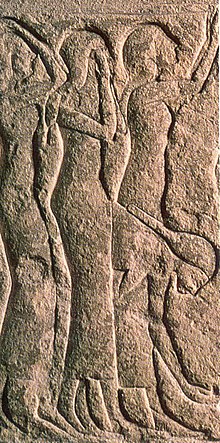
Egyptian women in a sorrowful gesture of mourning.
Mourning is the expression[1] of an feel that is the consequence of an consequence in life involving loss,[2] causing grief,[1] occurring equally a result of someone'south decease, specifically someone who was loved [2] although loss from death is not exclusively the cause of all experience of grief.[3]
The discussion is used to depict a complex of behaviours in which the bereaved participate or are expected to participate, the expression of which varies by civilisation.[1] Wearing black apparel is 1 do followed in many countries, though other forms of wearing apparel are seen. Those virtually affected past the loss of a loved 1 oft observe a period of mourning, marked by withdrawal from social events and quiet, respectful behavior. People may follow religious traditions for such occasions.
Mourning may apply to the death of, or anniversary of the death of, an important individual such every bit a local leader, monarch, religious figure, or fellow member of family. Country mourning may occur on such an occasion. In recent years, some traditions accept given fashion to less strict practices, though many community and traditions continue to be followed.
Stages of grief [edit]
Mourning is a personal and collective response which can vary depending on feelings and contexts. Elisabeth Kübler-Ross's theory of grief describes 5 separate periods of experience in the psychological and emotional processing of loss. These stages do non necessarily follow each other, and each flow is not inevitable.[iv] [5]
- Shock, denial: This short stage of mourning occurs when a person first discovers the loss, and refuses to believe it. This is a more than or less intense menses where emotions seem virtually absent. The affected person can faint and may even vomit without existence witting. After this short stage of mourning, the reality of loss sets in.
- Acrimony: This phase is characterized by a sense of outrage due to the loss, accompanied past guilt in some cases.
- Bargaining: This stage sees a person appoint in internal bargaining and negotiation.
- Depression: The depression phase can be the longest phase of the mourning process, characterized by bang-up sadness, questioning, and distress. Mourners in this phase sometimes feel that they will never complete their mourning. They have experienced a wide range of emotions and their sorrow is nifty.
- Credence: The last stage of mourning, where the bereaved gets ameliorate. The reality of the loss is much more understood and accepted. The bereaved can still feel sadness, but has regained total functioning and has besides reorganized life adjusting to the loss.
Grief can be defined as the menstruum following the death of someone close. This is both psychological and social:
- Psychological: When someone close to a person dies, the person enters a period of sorrow and questioning, or fifty-fifty nervous breakdown. There are 3 stages in the grieving procedure, encompassing the denial, depression and credence phases of Kübler-Ross' five step model.
- Social: The feelings and mental country of the mourner affect their ability to maintain or enter into relationships with others, including professional, personal and sexual relationships. After the customs of burial or cremating the deceased, many cultures follow a number of socially-prescribed traditions that may affect the habiliment a person wears and how long earlier, or even if, the mourner can remarry. These traditions are generally determined by the degree of kinship to and the social importance of the deceased.
Death tin can be a release for the mourner, in the case of the death of an abusive or tyrannical person, or when decease terminates the long, painful illness of a loved ane. Withal, this release may add remorse and guilt for the mourner.
Social customs and wearing apparel [edit]
Africa [edit]
Federal democratic republic of ethiopia [edit]
In Ethiopia, an Edir (variants "eddir" and "idir" in the Oromo linguistic communication) is a traditional community organization whose members help each other during the mourning process.[6] [vii] Members make monthly financial contributions forming the Edir 's fund. They are entitled to receive a certain sum of coin from this fund to help cover funeral and other expenses associated with deaths.[7] Additionally, Edir members condolement the mourners: female members accept turns doing housework, such as preparing nutrient for the mourning family unit, while male members usually take the responsibility to conform the funeral and erect a temporary tent to shelter guests who come to visit the mourning family.[seven] Edir members are required to stay with the mourning family and comfort them for three full days.[ commendation needed ]
Asia [edit]
East Asia [edit]
White is the traditional color of mourning in Chinese culture, with white clothes and hats formerly having been associated with death.[8] In imperial China, Confucian mourning obligations required even the emperor to retire from public affairs upon the decease of a parent. The traditional menses of mourning was nominally 3 years, but commonly 25–27 lunar months in exercise, and even shorter in the case of necessary officers; the emperor, for case, typically remained in seclusion for just 27 days.

The Japanese term for mourning dress is mofuku ( 喪服 ), referring to either primarily black Western-style formal wear or to black kimono and traditional clothing worn at funerals and Buddhist memorial services. Other colors, particularly reds and bright shades, are considered inappropriate for mourning dress. If wearing Western clothes, women may wear a single strand of white pearls. Japanese-mode mourning dress for women consists of a five-crested plain black silk kimono, a black obi and black accessories worn over white undergarments, black zōri and white tabi . Men's mourning dress consists of clothing worn on extremely formal occasions: a plain black silk five-crested kimono and blackness and white, or gray and white, striped hakama trousers over white undergarments, a blackness crested haori jacket with a white closure, white or blackness zōri and white tabi . It is customary for Japanese-way mourning dress to be worn merely by the immediate family and very shut friends of the deceased; other attendees wear Western-style mourning wearing apparel or subdued Western or Japanese formal clothes.
In Thailand, people habiliment blackness when attention a funeral. Black is considered the mourning color, although historically it was white. Widows may article of clothing purple when mourning the death of their spouse.[9]
Filipino practices for mourning bear influence from Chinese, Japanese, and folk Catholic beliefs. The firsthand family traditionally habiliment blackness, with white as a popular alternative. Other mourners may clothing subdued colours when paying respects, with the color red universally considered taboo inside 9–xl days of a death. It is believed that those who wear red, which is reserved for happier occasions, will die or suffer illness. Those who habiliment uniforms are allowed to wear a black armband, as are male person mourners in Barong tagalog. The bereaved, should they habiliment other clothes, vesture a small scrap of black ribbon or a blackness plastic pin on the left breast, which is tending of after mourning. The consumption of chicken during the wake and funeral is believed to bring decease to the bereaved, who are forbidden from seeing mourners off. Counting ix days from moment of death, a novena of Masses or other prayers, a ritual known equally the pasiyám (from the discussion for "nine"), is performed; the bodily funeral and burial may take place within this period or later, depending on circumstance. The spirit of the dead is believed to roam the earth until the 40th twenty-four hour period afterward death, when it is said to cross into the afterlife, echoing the 40 days betwixt Christ's Resurrection and Ascension into Heaven. The firsthand family on this day hold a Mass and small-scale feast, and again on the kickoff ceremony of the expiry, known equally the Babáng-luksâ , which is the commonly accepted endpoint of official mourning.
West Asia [edit]
In the Assyrian tradition, just after a person passes away, the mourning family host guests in an open house fashion. Only bitter coffee and tea are served, showcasing the sorrowful country of the family. On the funeral day, a memorial mass is held in the church building. At the graveyard, the people gather and burn incense effectually the grave equally clergy chant hymns in the Syriac language. The closest female relatives traditionally bemoan or lament in a public display of grief every bit the casket descends. A few others may sing a dirge or a sentimental threnody. During all these occasions, everyone is expected to apparel completely in black. Following the burial, anybody returns to the church building hall for afternoon lunch and eulogy. At the hall, the closest relatives sit on a long table facing the guests every bit many people walk by and offer their condolences. On the 3rd day, mourners customarily visit the grave site with a pastor to burn incense, symbolising Jesus' triumph over decease on the tertiary day. This is too done 40 days afterward the funeral (representing Jesus ascending to heaven), and one year later to conclude the mourning period. Mourners vesture only black until the 40 day mark and typically do not dance or celebrate any major events for one year.[x] [11]
Europe [edit]
Continental Europe [edit]

The custom of wearing unadorned black clothing for mourning dates back at to the lowest degree to the Roman Empire, when the toga pulla , made of dark-colored wool, was worn during mourning.
Through the Middle Ages and Renaissance, distinctive mourning was worn for general as well as personal loss; subsequently the St. Bartholomew's Day Massacre of Huguenots in French republic, Elizabeth I of England and her courtroom are said to take dressed in full mourning to receive the French Ambassador.
Widows and other women in mourning wore distinctive black caps and veils, generally in a bourgeois version of any electric current way.
In areas of Russia, the Czech Republic, Slovakia, Greece, Albania, Mexico, Portugal, and Spain, widows wearable black for the balance of their lives. The immediate family members of the deceased vesture black for an extended fourth dimension. Since the 1870s, mourning practices for some cultures, fifty-fifty those who have emigrated to the United States, are to wear black for at to the lowest degree two years, though lifelong blackness for widows remains in some parts of Europe.[ dubious ]
In Belgium, the Court went in public mourning later publication in the Moniteur Belge. In 1924, the court went in mourning afterward the death of Marie-Adélaïde, 1000 Duchess of Luxembourg, for x days, the knuckles of Montpensier for 5 days, and a total calendar month for the death of Princess Louise of Kingdom of belgium.
White mourning [edit]

The colour of deepest mourning among medieval European queens was white. In 1393, Parisians were treated to the unusual spectacle of a royal funeral carried out in white, for Leo V, King of Armenia, who died in exile.[12] This royal tradition survived in Espana until the finish of the 15th century. In 1934, Queen Wilhelmina of the Netherlands reintroduced white mourning after the death of her husband Prince Henry. It has since remained a tradition in the Dutch royal family.

Queen Wilhelmina of the Netherlands wearing white mourning subsequently the decease of married man in 1934.
In 2004, the four daughters of Queen Juliana of the Netherlands all wore white to their female parent'due south funeral. In 1993, the Castilian-born Queen Fabiola introduced it in Kingdom of belgium for the funeral of her husband, King Baudouin of Belgium. The custom for the Queens of France to wear deuil blanc ("white mourning") was the origin of the White Wardrobe created in 1938 by Norman Hartnell for Queen Elizabeth (after known every bit the Queen Female parent). She was required to make a Country visit to France while in mourning for her mother.
Britain [edit]
Today, no special dress or behaviour is obligatory for those in mourning in the general population, although ethnic and religious faiths accept specific rituals, and black is typically worn at funerals. Traditionally, even so, strict social rules were observed.
Georgian and Victorian Eras [edit]

Advertizement for Victorian mourning garb
By the 19th century, mourning behaviour in England had developed into a complex prepare of rules, particularly among the upper classes. For women, the community involved wearing heavy, concealing black clothing, and the use of heavy veils of blackness crêpe. The entire ensemble was colloquially known every bit "widow'south weeds" (from the Old English wǣd , meaning "garment"), and would either exist newly created wearable, or overdyed vesture the mourner already owned. Up until the later 18th century, the clothes of the deceased, unless they were considerably poor, were still listed in the inventories of the expressionless, as clothing constituted a relatively high expense.[13]

Special caps and bonnets, commonly in black or other dark colours, were worn with these ensembles; mourning jewellery, oft made of jet, was also worn, and became highly popular in the Victorian era. Jewellery was besides occasionally fabricated from the pilus of the deceased. The wealthy would wear cameos or lockets designed to concur a lock of the deceased's hair or some similar relic.
Widows were expected to clothing special clothes to bespeak that they were in mourning for upwardly to four years after the death, although a widow could choose to article of clothing such attire for the balance of her life. To change one'southward clothing earlier than this was considered disrespectful to the deceased, and, if the widow was still young and attractive, suggestive of potential sexual promiscuity. Those subject to the rules were slowly immune to re-introduce conventional wear at specific times; such stages were known by such terms every bit "full mourning", "half mourning", and like descriptions. For half mourning, muted colours such as lilac, gray and lavander could be introduced.[14]

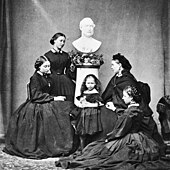
The five daughters of Prince Albert wore black dresses and posed for a portrait with his statue following his death in 1861.
Friends, acquaintances, and employees wore mourning to a greater or lesser degree depending on their human relationship to the deceased. Mourning was worn for six months subsequently the death of a sibling. Parents would vesture mourning for a child for "as long as they [felt] then disposed". A widow was supposed to vesture mourning for two years, and was not supposed to enter society for 12 months. No lady or admirer in mourning was supposed to attend social events while in deep mourning. In general, servants wore blackness armbands when there had been a death in the household. However, among polite company, the wearing of a simple black armband was seen as advisable only for military men, or others compelled to wear uniform in the grade of their duties—a black arm band instead of proper mourning dress was seen every bit a degradation of proper etiquette, and to be avoided.[15] In general, men were expected to habiliment mourning suits (not to be dislocated with morning suits) of black apron coats with matching trousers and waistcoats. In the later interbellum period between World War I and Globe War Ii, as the apron coat became increasingly rare, the mourning suit consisted of a blackness morning glaze with blackness trousers and waistcoat, essentially a black version of the morning arrange worn to weddings and other occasions, which would normally include coloured waistcoats and striped or checked trousers.
Formal mourning culminated during the reign of Queen Victoria, whose long and conspicuous grief over the death of her married man, Prince Albert, heavily influenced society. Although manner began to be more functional and less restrictive for the succeeding Edwardian era, advisable dress for men and women—including that for the period of mourning—was still strictly prescribed and rigidly adhered to. In 2014, The Metropolitan Museum of Modern Art mounted an exhibition of women'south mourning attire from the 19th century, entitled Death Becomes Her: A Century of Mourning Attire.[16]
The customs were not universally supported, with Charles Voysey writing that it "adds needlessly to the gloom and dejection of really afflicted relatives must exist apparent to all who have ever taken part in these miserable rites".[17]
The rules were gradually relaxed over time, and information technology became acceptable do for both sexes to dress in nighttime colours for up to a year after a death in the family. By the late 20th century, this no longer applied, and blackness had been widely adopted by women in cities as a fashionable colour.
North America [edit]
United States [edit]


Poor orphans depicted wearing a makeshift blackness armband to mourn for their mother (Piece of work by F.M. Brown), 1865
Mourning generally followed English forms into the 20th century. Black dress is still considered proper etiquette for attendance at funerals, but extended periods of wearing blackness dress are no longer expected. However, attendance at social functions such as weddings when a family is in deep mourning is frowned upon.[ commendation needed ] Men who share their male parent'southward given proper noun and use a suffix such equally "Junior" retain the suffix at least until the father'due south funeral is consummate.[ citation needed ]
In the antebellum S, with social mores that imitated those of England, mourning was only as strictly observed past the upper classes.
In the 19th century, mourning could be quite expensive, as it required a whole new set of clothes and accessories or, at the very least, overdyeing existing garments and taking them out of daily employ. For a poorer family, this was a strain on resource.[xviii] [ full citation needed ]
At the end of The Wonderful Wizard of Oz, Dorothy explains to Glinda that she must return habitation because her aunt and uncle cannot afford to become into mourning for her considering it was too expensive.[nineteen]
A late 20th and early on 21st century North American mourning miracle is the rear window memorial decal. This is a large vinyl window-cling decal memorializing a deceased loved one, prominently displayed in the rear windows of cars and trucks belonging to close family members and sometimes friends. Information technology often contains nascency and decease dates, although some contain sentimental phrases or designs as well.[20]
The Pacific [edit]
Tonga [edit]
In Tonga, family members of deceased persons wear blackness for an extended time, with big plain Taʻovala. Oftentimes, blackness bunting is hung from homes and buildings. In the case of the death of royalty, the entire country adopts mourning clothes and black and purple bunting is displayed from most buildings.
Country and official mourning [edit]
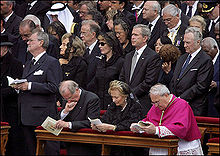
States usually declare a menstruum of 'official mourning' afterwards the death of a caput of land. in the example of a monarchy, court mourning refers to mourning during a set flow following the death of a public figure or fellow member of a imperial family unit. The protocols for mourning vary, merely typically include the lowering or posting half-mast of flags on public buildings. In dissimilarity, the Royal Standard of the U.k. is not flown at one-half-mast upon the death of a head of land, as there is always a monarch on the throne.
The degree and duration of public mourning is generally decreed by a protocol officer. It was not unusual for the British courtroom to declare that all citizens should wear full mourning for a specified catamenia after the death of the monarch or that the members of the court should wear full- or half-mourning for an extended time. On the expiry of Queen Victoria (22 January 1901), the Canada Gazette published an "actress" edition announcing that court mourning would continue until 24 January 1902. It directed the public to wear deep mourning until 6 March 1901 and half-mourning until 17 April 1901. As they had done in earlier years for Queen Victoria, her son King Edward VII, his wife Queen Alexandra and the Queen Elizabeth The Queen Mother, the royal family unit went into mourning on the death of Prince Philip in Apr 2021.[21] The black-and-white costumes designed by Cecil Beaton for the Regal Ascot sequence in My Fair Lady were inspired by the "Black Ascot" of 1910, when the court was in mourning for Edward 7.

Thailand national flag flown at one-half mast at a high school in Bangkok during the country mourning of the King Bhumibol
The principle of continuity of the State, however, is also respected in mourning, and is reflected in the French saying "Le Roi est mort, vive le Roi!" ("The king is expressionless, long live the male monarch!"). Regardless of the formalities of mourning, the ability of state is handed on, typically immediately if the succession is uncontested. A curt interruption of piece of work in the civil service, nonetheless, may result from one or more days of closing the offices, particularly on the mean solar day of the land funeral.
In January 2006, on the death of Jaber Al-Ahmad Al-Jaber Al-Sabah, the emir of Kuwait, a mourning menses of twoscore days was declared. In Tonga, the official mourning lasts for a year; the heir is crowned later on this catamenia has passed.
Religions and community [edit]
Confucianism [edit]
There are five grades of mourning obligations in the Confucian Lawmaking. A person is expected to accolade about of those descended from their great-great-grandfather, and most of their wives. The death of a person's father and mother would merit 27 months of mourning; the death of a person's grandfather on the male side, every bit well equally their grandfather'south wife, would be grade two, or necessitate 12 months of mourning. A paternal uncle is class three, at ix months, with grade four is reserved for one'southward father's first cousin, maternal grandparents, siblings and sister's children (five months). First cousins once removed, second cousins and the parents of a man'due south wife's are considered grade five (three months).[22]
Buddhism [edit]
Christianity [edit]
Eastern Christianity [edit]
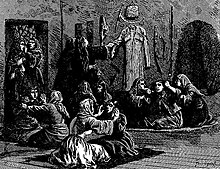
A mourning ritual of the Mingrelians in Georgia, c. 1884.
Orthodox Christians normally hold the funeral either the day after death or on the third mean solar day, and always during the daytime. In traditional Orthodox communities, the body of the departed would be washed and prepared for burying by family unit or friends, then placed in the bury in the home. A house in mourning would be recognizable by the lid of the bury, with a cross on information technology, and often adorned with flowers, attack the porch by the forepart door.
Special prayers are held on the 3rd, 7th or ninth (number varies in different national churches), and 40th days after death; the tertiary, sixth and ninth or twelfth month;[23] and annually thereafter in a memorial service,[24] for up to three generations. Kolyva is ceremoniously used to honor the dead.
Sometimes men in mourning will not shave for the 40 days.[25] In Greece and other Orthodox countries, it is non uncommon for widows to remain in mourning dress for the rest of their lives.
When an Orthodox bishop dies, a successor is not elected until subsequently the 40 days of mourning are completed, during which menstruation his diocese is said to be "widowed".
The 40th day has peachy significance in Orthodox religion, considered the period during which soul of deceased wanders on globe. On the 40th mean solar day, the rise of the deceased's soul occurs, and is the nigh important mean solar day in mourning period, when special prayers are held on the grave site of deceased.
Equally in the Roman Catholic rites, there tin be symbolic mourning. During Holy Calendar week, some temples in the Church of Cyprus draw black defunction beyond the icons.[26] The services of Skillful Friday and Holy Sabbatum morning are patterned in function on the Orthodox Christian burial service, and funeral lamentations.
Western Christianity [edit]


The European social forms are, in full general, forms of Christian religious expression transferred to the greater community.
In the Roman Cosmic Church, the Mass of Paul Six, adopted in 1969, allows several options for the liturgical colour used in Masses for the Expressionless. Before the liturgical reform, black was the ordinary color for funeral Masses; in the revised utilise, several options are bachelor, though black is the norm. Co-ordinate to the Full general Instruction of the Roman Missal (§346d-e), blackness vestments is to be worn at Offices and Masses for the dead; an indult was given for several countries to use violet or white vestments, and in some of those nations those colours have largely supplanted the use of black vestments.
Christian churches often get into mourning symbolically during the period of Lent to commemorate the sacrifice and expiry of Jesus. Customs vary amongst the denominations and include the covering or removal of statuary, icons and paintings, and utilize of special liturgical colors, such equally violet/purple, during Lent and Holy Week.
In more formal congregations, parishioners also wearing apparel co-ordinate to specific forms during Holy Week, particularly on Maundy Th and Good Fri, when information technology is common to wear black or sombre dress or the liturgical color imperial.
Special prayers are held on the third, seventh, and 30th days after death;[27]
Prayers are held on the third mean solar day, because Jesus rose over again after three days in the sepulchre (1 Corinthians xv:4).[28]
Prayers are held on the seventh day, because Joseph mourned his begetter Jacob vii days (Genesis 50:10)[29] and in Volume of Sirach is written that "vii days the dead are mourned" (Ecclesiasticus 22:13).[30]
Prayers are held on the thirtieth solar day, because Aaron (Numbers 20:30)[31] and Moses (Deuteronomy 34:eight)[32] were mourned 30 days.
Hinduism [edit]
Decease is not seen every bit the final "terminate" in Hinduism, simply is seen as a turning point in the seemingly endless journey of the indestructible "atman", or soul, through innumerable bodies of animals and people. Hence, Hinduism prohibits excessive mourning or lamentation upon death, every bit this can hinder the passage of the departed soul towards its journey ahead: "Equally mourners will not help the dead in this earth, therefore (the relatives) should not weep, but perform the obsequies to the best of their power."[33]
Hindu mourning is described in dharma shastras.[34] [35] It begins immediately after the cremation of the body and ends on the morning of the thirteenth day. Traditionally, the torso is cremated within 24 hours later death; even so, cremations are not held later dusk or before sunrise. Immediately later on the death, an oil lamp is lit well-nigh the deceased, and this lamp is kept burning for three days.
Hinduism associates death with ritual impurity for the firsthand blood family of the deceased, hence during these mourning days, the firsthand family unit must not perform any religious ceremonies (except funerals), must not visit temples or other sacred places, must not serve the sages (holy men), must non give alms, must not read or recite from the sacred scriptures, nor can they attend social functions such as marriages and parties. The family of the deceased is not expected to serve whatever visiting guests food or potable. It is customary that the visiting guests practise non eat or drink in the house where the death has occurred. The family unit in mourning are required to breast-stroke twice a day, consume a single elementary vegetarian meal, and endeavour to cope with their loss.
On the day on which the death has occurred, the family do not melt; hence usually close family and friends volition provide food for the mourning family. White clothing (the color of purity) is the colour of mourning, and many will vesture white during the mourning period.
The male members of the family do non cut their hair or shave, and the female members of the family do non wash their hair until the 10th day after the death. If the deceased was young and single, the "Narayan Bali" is performed past the Pandits. The Mantras of "Bhairon Paath" are recited. This ritual is performed through the person who has given the Mukhagni (Ritual of giving fire to the expressionless body).
On the morn of the 13th day, a Śrāddha ceremony is performed. The main anniversary involves a fire sacrifice, in which offerings are given to the ancestors and to gods, to ensure the deceased has a peaceful afterlife. Pind Sammelan is performed to ensure the involvement of the departed soul with that of God. Typically after the anniversary, the family cleans and washes all the idols in the family shrine; and flowers, fruits, h2o and purified food are offered to the gods. Then, the family is ready to break the menses of mourning and return to daily life.
Islam [edit]

Female mourners at the reburial of newly identified victims of the Srebrenica massacre in Bosnia.
In Shi'a Islam, examples of mourning practices are held annually in the month of Muharram, the first calendar month of Islamic Lunar calendar. This mourning is held in the commemoration of Imam Al Husayn ibn Ali, who was martyred along with his 72 companions past Yazid bin Muawiyah. Shi'a Muslims wear blackness clothes and accept out processions on road to mourn on the tragedy of Karbala. Shi'a Muslims likewise mourn the expiry of Fatima (the only girl of Muhammad) and the Shi'a Imams.
Mourning is observed in Islam by increased devotion, receiving visitors and condolences, and avoiding decorative habiliment and jewelry. Loved ones and relatives are to observe a iii-mean solar day mourning menses.[36] Widows observe an extended mourning period (Iddah), four months and x days[37] long, in accordance with the Qur'an ii:234. During this time, she is not to remarry, move from her abode, or vesture decorative clothing or jewelry.
Grief at the death of a dear person is normal, and weeping for the dead is allowed in Islam.[38] What is prohibited is to limited grief by wailing ("bewailing" refers to mourning in a loud voice), shrieking, tearing hair or wearing apparel, breaking things, scratching faces, or uttering phrases that make a Muslim lose religion.[39]
Directives for widows [edit]
The Qur'an prohibits widows from engaging themselves for 4 lunar months and x days afterwards the death of their husbands. Co-ordinate to Qur'an:
And those of you who die and leave widows behind, they should keep themselves in waiting for 4 months and ten days. Then when they have fulfilled their term, at that place is no blame on you about what they do with themselves in accordance with the norms [of society]. And Allah is well acquainted with what y'all exercise. And in that location is also no blame on you if you tacitly send a marriage proposal to these women or hold it in your hearts. Allah knows that y'all would definitely talk to them. [Do and so] but practice not make a undercover contract. Of course you can say something in accord with the norms [of the society]. And do not make up one's mind to marry until the law reaches its term. And know that Allah has noesis of what is in your hearts; so exist fearful of Him and know that Allah is Most forgiving and Virtually Forbearing.
Islamic scholars consider this directive a balance between mourning a husband'south death and protection of the widow from censure that she became interested in remarrying too soon afterwards her husband's death.[40] This is also to ascertain whether or not she is pregnant.[41]
Judaism [edit]
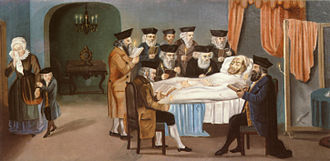
A adult female mourning the death of her husband, Prague, 1772
Judaism looks upon mourning as a process by which the stricken can re-enter into society, and then provides a series of customs that make this process gradual. The starting time phase, observed as all the stages are by immediate relatives (parents, spouse, siblings and children) is the Shiva (literally meaning "vii"), which consists of the commencement 7 days afterward the funeral. The second stage is the Shloshim (thirty), referring to the thirty days post-obit the death. The menstruum of mourning later on the death of a parent lasts one year. Each stage places lighter demands and restrictions than the previous one in order to reintegrate the bereaved into normal life.
The most known and central stage is Shiva , which is a Jewish mourning do in which people adjust their behaviour as an expression of their bereavement for the week immediately after the burying. In the Due west, typically, mirrors are covered and a small tear is made in an item of clothing to betoken a lack of involvement in personal vanity. The bereaved clothes just and sit on the flooring, brusque stools or boxes rather than chairs when receiving the condolences of visitors. In some cases relatives or friends accept intendance of the bereaved's house chores, as cooking and cleaning. English speakers employ the expression "to sit down shiva".
During the Shloshim , the mourners are no longer expected to sit down on the floor or be taken care of (cooking/cleaning). However, some customs still apply. There is a prohibition on getting married or attending any sort of celebrations and men refrain from shaving or cutting their hair.
Restrictions during the year of mourning include not wearing new clothes, not listening to music and not attending celebrations. In improver, the sons of the deceased recite the Kaddish prayer for the first eleven months of the twelvemonth.
See also [edit]
- Burial
- Cemetery
- Cremation
- Expiry wail
- Half-mast
- Month'southward Mind
- Mourning portraits
- Mourning ring
- Mourning sickness
- Requiem
- Rudaali (Indian film)
- Victorian mode
- Wake (ceremony)
- Widow's cap
References [edit]
Citations [edit]
- ^ a b c Robben, Antonius C. 1000. Thou. (4 Feb 2009). Robben, Antonius C. One thousand. M. (ed.). Death, Mourning, and Burial A Cross-Cultural Reader (Ebook). Wiley. p. seven. ISBN9781405137508 . Retrieved May 28, 2021 – via https://world wide web.google.co.uk/books/edition/Death_Mourning_and_Burial/pYZ26lnNjG8C?hl=en&gbpv=0.
In Death, Mourning, and Burial, an indispensable introduction to the anthropology of decease, readers will find a rich pick of some of the finest ethnographic work on this fascinating topic...
- ^ a b Brennan, Michael (xiv January 2009). Mourning and Disaster Finding Meaning in the Mourning for Hillsborough and Diana (Ebook). Cambridge Scholars Publications (published 2008). p. ii. ISBN9781443803793 . Retrieved May 28, 2021 – via Google books https://www.google.co.united kingdom of great britain and northern ireland/books/edition/Mourning_and_Disaster/wbYLBwAAQBAJ?hl=en&gbpv=0.
The Hillsborough stadium disaster of 15 April 1989 and the death of Princess Diana on 31 August 1997 sparked expressivist scenes of public mourning hitherto unseen inside the context of British guild...
- ^ Hugstad, Kristi (July 26, 2017). "Grieving Losses Other Than Death". www.huffpost.com. Archived from the original on May 28, 2021. Retrieved May 28, 2021.
- ^ "Understanding the Five Stages of Grief". Cruse Bereavement Care. February 12, 2021. Retrieved May 28, 2021.
- ^ "growing-around-grief". www.cruse.org.great britain (Cruse Bereavement Intendance) . Retrieved May 28, 2021.
- ^ Wokineh Kelbessa (2001). "Traditional Oromo Attitudes towards the Environment: An Argument for Environmentally Sound Development" (PDF). Social Science Enquiry Report Serial (19): 89. Retrieved 4 February 2014.
- ^ a b c Mark and Maggie Banga (2012-03-02). "Mourning and healing". Comboni Lay Missionaries. Retrieved 2015-06-01 .
{{cite web}}: CS1 maint: uses authors parameter (link) - ^ "Psychology of Color: Does a specific color indicate a specific emotion? By Steve Hullfish | July 19, 2012". Archived from the original on March 4, 2015. Retrieved December 6, 2017.
- ^ Knos, T. "Colors of Mourning". mysendoff.com . Retrieved 21 February 2018.
- ^ Troop, Sarah. "The Hungry Mourner." Modern Loss, 22 Jul 2014. Web. 24 Jan 2016.
- ^ Assyrian Rituals of Life-Cycle Events by Yoab Benjamin
- ^ Johan Huizinga, The Waning of the Middle Ages (1919, 1924:41).
- ^ Rothstein, Natalie (1990). Silk Designs of the Eighteenth Century In The Drove of the Victoria and Albert Museum. London: Thames and Hudson. p. 23.
- ^ "English Funeral and mourning habiliment". England: The Other Within: Analysing the English Collections at the Pitt Rivers Museum. Oxford Academy. Retrieved 2015-05-22 .
- ^ The Universal Cyclopædia, W. Ralston Balch, Griffith Farran Okeden & Welsh, London, c. 1887
- ^ "Decease Becomes Her: A Century of Mourning Attire". www.metmuseum.org . Retrieved 2019-09-30 .
- ^ Voysey, Charles (31 March 1873). The Custom of Wearing Mourning. London.
- ^ See Taylor, Jupp and Litten.
- ^ Fifty. Frank Baum, Michael Patrick Hearn (1973). The Annotated Wizard of Oz. p. 334. ISBN978-0-517-50086-half-dozen.
- ^ Engel, Allison (December 11, 2005). "In the Rear Window, Tributes to the Dead". New York Times . Retrieved 11 May 2019.
- ^ Holt, Bethan (fifteen April 2021). "The fascinating history of royal family mourning dress codes". The Sydney Morning Herald.
- ^ Ebrey, Patricia B. (1993). The Inner Quarters. Berkeley: University of California Press. p. 51. ISBN978-0-520-08156-7.
- ^ "Archdiocese of Thyateira and Great Britain – Funerals & Memorials". Thyateira.org.great britain. Retrieved 2014-04-17 .
- ^ A. C. Parker (2009-01-05). "Melting Pot Family: Kolyva for Aunt Bea". Meltingpotfamily.blogspot.com. Retrieved 2014-04-17 .
- ^ "Cultural Data – Bereavement in Crete & Greece". Living in Crete . Retrieved 2014-04-17 .
- ^ Clark, Five. (2000) Why Angels Autumn: A Journeying Through Orthodox Europe from Byzantium to Kosovo (Basingstoke, Palgrave Macmillan)
- ^ Skg, Admin. "Почему католики отмечают 7 дней и 30 дней после смерти человека?". sib-cosmic.ru (in Russian). Retrieved 2021-07-26 .
- ^ "Vulgate - Douay-Rheims - Knox Bible adjacent". catholicbible.online . Retrieved 2021-07-26 .
- ^ "Vulgate - Douay-Rheims - Knox Bible adjacent". catholicbible.online . Retrieved 2021-07-26 .
- ^ "Vulgate - Douay-Rheims - Knox Bible adjacent". catholicbible.online . Retrieved 2021-07-26 .
- ^ "Vulgate - Douay-Rheims - Knox Bible next". catholicbible.online . Retrieved 2021-07-26 .
- ^ "Vulgate - Douay-Rheims - Knox Bible side by side". catholicbible.online . Retrieved 2021-07-26 .
- ^ Viṣṇu smṛti 20.xxx
- ^ Viṣṇu smṛti twenty.xxx–40
- ^ Āpastamba dharma sūtra 2.6.fifteen.half dozen–9
- ^ Sahih Muslim Volume two, Book 23
- ^ (Number 370-371)
- ^ (Number 391)
- ^ (Number 375-393)
- ^ Islahi(1986), pp. 546
- ^ Saleem, Shehzad (March 2004). "The Social Directives of Islam: Distinctive Aspects of Ghamidi's Interpretation". Renaissance Islamic Journal. Lahore: Al-Mawrid. Archived from the original on 2007-04-03.
Bibliography [edit]
- The Canada Gazette
- Vesture of Ancient Rome
- Charles Spencer, Cecil Beaton: Stage and Picture Designs, London: University Editions, 1975. (no ISBN)
- Karen Rae Mehaffey, The After-Life: Mourning Rituals and the Mid-Victorians, Lasar Writers Publishing, 1993. (no ISBN)
- Silverish, Catherine B. (2007). "Womb Envy: Loss and Grief of the Maternal Body". Psychoanalytic Review. 94 (3): 409–430. doi:10.1521/prev.2007.94.three.409. PMID 17581094. Retrieved May 26, 2021.
- "Grief vs. Mourning: What'southward the Difference?". www.therecoveryvillage.com . Retrieved May 26, 2021.
External links [edit]
 | Wikiquote has quotations related to: Mourning |
 | Wait upwards mourning in Wiktionary, the free lexicon. |
 | Wikimedia Commons has media related to Mourning. |
- Victorian mourning garb at Morbid Outlook.
- The Jewish Way in Expiry and Mourning By Maurice Lamm
- To Those Who Mourn a Christian view by Max Heindel
- Beyond The Broken Heart a Christian view past Julie Yarbrough
- Free info on Jewish customs related to death, mourning, Kaddish, shiva, yahrtzeilt, the hil, & the afterlife
Source: https://en.wikipedia.org/wiki/Mourning
0 Response to "Mourning While Black': Family, Including Dead Woman, Kicked Out of Church by Priest"
Post a Comment