Alkenes Can Be Converted to Alcohols by Hydroboration-oxidation
Hydroboration–oxidation reaction is a 2-stride hydration reaction that converts an alkene into an alcohol.[ane] The procedure results in the syn add-on of a hydrogen and a hydroxyl group where the double bail had been. Hydroboration–oxidation is an anti-Markovnikov reaction, with the hydroxyl group attaching to the less-substituted carbon. The reaction thus provides a more stereospecific and complementary regiochemical alternative to other hydration reactions such equally acid-catalyzed addition and the oxymercuration–reduction process. The reaction was outset reported by Herbert C. Brown in the late 1950s[2] and it was recognized in his receiving the Nobel Prize in Chemistry in 1979.
The full general course of the reaction is equally follows:

Tetrahydrofuran (THF) is the archetypal solvent used for hydroboration.
Mechanism and scope [edit]
Hydroboration step [edit]
In the first step, borane (BH3) adds to the double bond, transferring one of the hydrogen atoms to the carbon next to the ane that becomes bonded to the boron. This hydroboration is repeated two additional times, successively reacting each B–H bond so that three alkenes add together to each BH3. The resulting trialkylborane is treated with hydrogen peroxide in the second step. This process replaces the B-C bonds with HO-C bonds. The boron reagent is converted to boric acid. The reaction was originally described by H.C. Chocolate-brown in 1957 for the conversion of 1-hexene into ane-hexanol.[3]

Knowing that the group containing the boron volition be replaced by a hydroxyl group, information technology can exist seen that the initial hydroboration pace determines the regioselectivity. Hydroboration proceeds in an anti-Markovnikov manner. The reaction sequence is also stereospecific, giving syn add-on (on the same face of the alkene): the hydroboration is syn-selective and the oxidation replaces the boron with hydroxyl having the same geometric position. Thus 1-methylcyclopentene reacts with diborane predominantly to requite trans-1-hydroxy-2-methylcyclopentane[4]—the newly added H and OH are cis to each other.
Until all hydrogens attached to boron have been transferred away, the boron grouping BH2 volition continue adding to more alkenes. This ways that one mole of hydroborane will undergo the reaction with 3 moles of alkene. Furthermore, it is not necessary for the hydroborane to take more than than one hydrogen. For instance, reagents of the type RtwoBH are commonly used, where R can represents the balance of the molecule. Such modified hydroboration reagents include 9-BBN, catecholborane, and disiamylborane.
Oxidation step [edit]
In the second footstep of the reaction sequence, the nucleophilic hydroperoxide anion attacks the boron atom. Alkyl migration to oxygen gives the alkyl borane with memory of stereochemistry (in reality, the reaction occurs via the trialkyl borate B(OR)3, rather than the monoalkyl borinic ester BHiiOR).
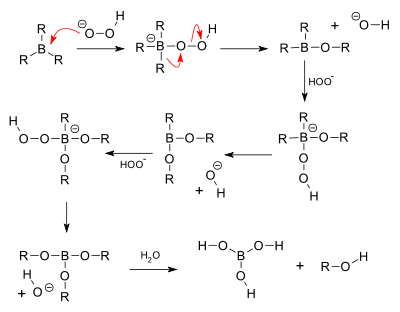
Hydroboration–oxidation machinery
The 'H' atom in the reaction comes from B2H6, the 'O' atom comes from hydrogen peroxide (HtwoOtwo) whereas the O attached 'H' atom comes from the solvent (refer mechanism).
Alkyne hydroboration [edit]
A hydroboration reaction also takes place on alkynes. Again the mode of action is syn and secondary reaction products are aldehydes from final alkynes and ketones from internal alkynes. In guild to prevent hydroboration across both the pi-bonds, a bulky borane like disiamyl (di-sec-iso-amyl) borane is used.[5]
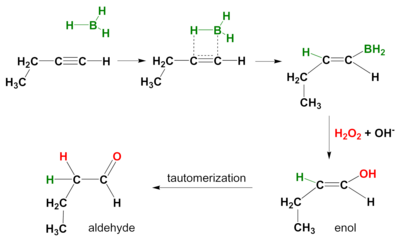
Hydroboration–oxidation of terminal alkyne
Culling oxidations [edit]
Use of other oxidants instead of hydrogen peroxide can lead to carbonyl products rather than alcohols from alkenes. Due north-Methylmorpholine Due north-oxide with catalytic tetrapropylammonium perruthenate converts the alkylborane into a carbonyl, thus a ketone or aldehyde production depending on what other groups were attached to that carbon in the original alkene.[half dozen] Various dichromates or related chromium(Six) reagents give ketones as well, only give carboxylic acids instead of aldehydes for concluding alkenes.[7]
References [edit]
- ^ Marc G. Loudon (2002). "Addition Reactions of Alkenes". Organic Chemistry (fourth ed.). New York: Oxford University Press. pp. 168–172. ISBN0-19-511999-ane.
- ^ Brown, H. C.; Zweifel, 1000. (1959). "A STEREOSPECIFIC CIS HYDRATION OF THE DOUBLE Bond IN CYCLIC DERIVATIVES". Journal of the American Chemical Society. 81: 247. doi:10.1021/ja01510a059.
- ^ Dark-brown, H.; Rao, B. C. (1957). "Communications – Selective Conversion of Olefins into Organoboranes Through Competitive Hydroboration, Isomerization and Deportation Reactions". Journal of Organic Chemistry. 22 (ix): 1137. doi:10.1021/jo01360a626.
- ^ Hawthorne, M. F. (1961). "Amine Boranes. 8. The Hydroboration of Last Olefins, Dienes and Final Acetylenes with Trimethylamine t-Butylborane". Journal of the American Chemical Society. 83 (11): 2541–2544. doi:ten.1021/ja01472a027.
- ^ Dark-brown, H. C.; Gupta, Due south. K. (1972). "Catecholborane (1,three,two-benzodioxaorole) as a new, full general monohydroboration reagent for alkynes. Convenient synthesis of alkeneboronic esters and acids from alkynes via hydroboration". Journal of the American Chemical Society. 94 (12): 4370. doi:10.1021/ja00767a072.
- ^ Yates, Matthew H. (1997). "Ane-pot conversion of olefins to carbonyl compounds by hydroboration / NMO–TPAP oxidation". Tetrahedron Lett. 38: 2813–2816. doi:10.1016/S0040-4039(97)00476-0.
- ^ Brown, Herbert C.; Kulkarni, Shekhar 5.; Khanna, Vijay V.; Patil, Virendra D.; Racherla, Uday S. (1992). "Organoboranes for Synthesis. 14. Convenient Procedures for the Direct Oxidation of Organoboranes from Terminal Alkenes to Carboxylic Acids". J. Org. Chem. 57 (23): 6173–6177. doi:ten.1021/jo00049a024.
External links [edit]
- Organic Chemistry Portal. Hydroboration (including contempo literature). https://www.organic-chemistry.org/namedreactions/brownish-hydroboration.shtm
Source: https://en.wikipedia.org/wiki/Hydroboration%E2%80%93oxidation_reaction#:~:text=Hydroboration%E2%80%93oxidation%20reaction%20is%20a,the%20double%20bond%20had%20been.&text=Tetrahydrofuran%20(THF)%20is%20the%20archetypal%20solvent%20used%20for%20hydroboration.
0 Response to "Alkenes Can Be Converted to Alcohols by Hydroboration-oxidation"
Post a Comment